MONDAY, 1ST OF OCTOBER, 2018
For this session, we started going over the dynamics of a bouncing ball.
Starting off, we watched a TED-Ed video about timing and spacing in animation. It's primary discussion about bouncing balls proved relevant and helpful.
(credit: TED on YouTube)
After the TED video, we talked about how the ball bounce incorporates many important aspects of animation into it's movement, including:
- Path of action
- Arcs
- Momentum
- Timing
- Keyframes / Inbetweening
- Weight
- Speed
Path of action was further elaborated on, when moving onto our task for the day. The Path of Action is the direction that a character or object takes when it moves, and contains arcs and specific timings. For our ball bounce exercise, we should consider the weight of the balls and their speed. As the ball descends, it should gain speed, and lose it as it ascends back up. More frames should be bunched together near the top of an arc, showing the speed and ease of the ball.
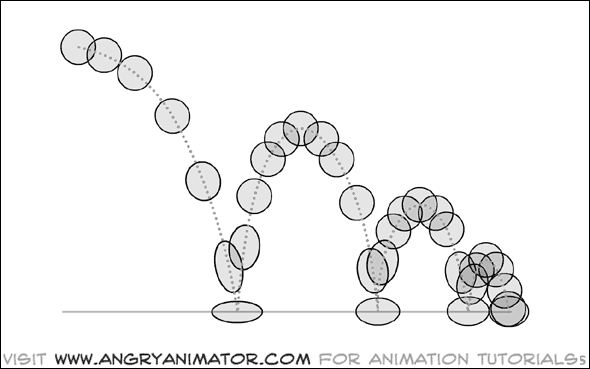
(credit: www.angryanimator.com)
We also went over squash and stretch, a technique commonly used in more cartoony animation which gives things a more bouncy feel, and an elasticity to whatever uses the technique. For a ball with squash and stretch applied to it, it elongates as it falls, and squashes flat as it comes into contact with the ground. An important rule to remember with this technique is that the object must ALWAYS have the same volume. If the ball increases by the Y axis, it must decrease by the X axis, with the inverse also ringing true. When the object reaches it's slowest point, it returns to it's regular state.
After that, we got started on our animations. I made two; one of a regular bouncing ball, and one with squash and stretch applied. We used F12 paper and peg bars; the "traditional" animation method.
I didn't run into any real issues with this task, and I feel I completed it in about average time. I didn't feel like I was going too quickly and rushing, which was a worry I'd had last week. At the same time, I wasn't going really slowly to the point of annoying myself.
After the exercise was complete, we were introduced to Alan Becker's 12 Principles of Animation series, based upon the 12 rules established by Disney animators Frank Thomas and Ollie Johnston. I'd watched Becker's series before, as well as his "Animation vs Animator" series. The principle we watched first was about squash and stretch.
(credit: Alan Becker on YouTube)
Overall, I feel like this session was great! It was definitely an essential part of animation, as I had guessed before the course. I don't think there's anything I would've changed really, maybe just given a half hour longer to capture my second animation in the same session, instead of going back and recording it later.

No comments:
Post a Comment